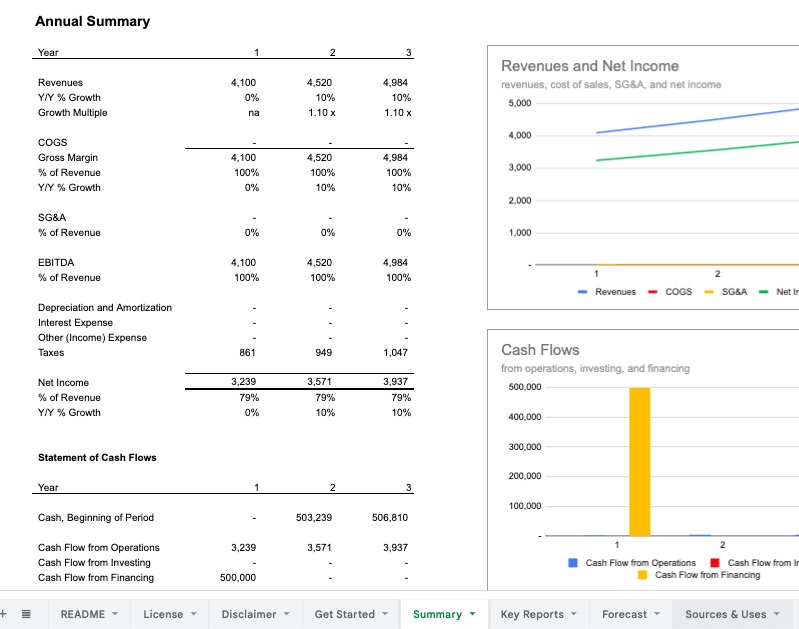
Revenue represents the financial value a business earns by delivering products or services to customers. It is the first section at the top of the Income Statement and is one of the most important indicators of business performance.
For many businesses revenues does not necessarily equal cash. Meaning, when a company "recognizes" revenues - the amount of revenues that the company reports that it earned that period - does not necessarily equal the amount of cash received by the business in that period. To take a step back, the idea of revenue recognition stems from the matching principle:
The matching principle is a fundamental concept in accounting that ensures expenses are recognized in the same period as the revenues they generate. This principle is integral to accrual accounting, where transactions are recorded when they occur, rather than when cash changes hands. The core idea behind the matching principle is to provide a more accurate picture of a company's financial performance and profitability within a specific period.
Under accrual accounting revenues are recognized, or counted, when value has been delivered, matching the timing of economic activity with the financial reporting of that activity. Of course, many businesses choose to use cash accounting instead of accrual accounting, and many businesses are not required to use accrual accounting, but the majority of businesses using Foresight templates will choose to use accrual accounting, and thus the templates are built for accrual accounting and revenue recognition considerations.
Methods of revenue recognition
Revenue recognition methods can vary, because different types of business deliver value in different ways, here are a few examples:
- Point-in-Time revenue recognition is used for products and services that are delivered and fulfilled at a specific moment or period. Examples include consumer goods, digital goods, one-time services, etc.
- Over-Time revenue recognition is used when services deliver value over multiple periods. Examples include software-as-a-service (SaaS), managed services, support contracts, etc. Note that in many instances with this the company is paid upfront but revenue is recognized ratably over the service period. Note this can be ratable (even over time) or progress-based (proportional to the value delivered over time).
- Milestone or Percentage-of-Completion recognizes revenue based on the achievement of specific milestones or progress towards completion, and can be irregular over time. Common in construction, implementatino services, enterprise projects.
- Usage-Based revenue recognition is based on the variable usage of a product or service, including services like APIs, compute time, email campaigns, etc.
Companies may use different revenue recognition methods for different products and services to correctly account for the multiple ways they deliver value. Examples include subscriptions and one-time addons or onboarding fees, hardware sales and subscriptions, usage-based fees on top of subscriptions, professional services mixed with self-service subscription.
Bookings, billings, revenues, and cash
Understanding how revenues and cash flow through consolidated financial statements is a fundamental concept to understanding business models.
Bookings represents the total value of customer commitments signed in a period, which may include a commitment to payments over multiple periods. Bookings measures sales momentum and pipeline conversion, but it is not an item on a financial statement.
Billings represents the value a company invoices to its customers, which may or may not be equal to the revenues in a single period. Billing patterns may be monthly, quarterly, annually, milestone-based, or usage-based, and the pattern selected will significantly influence cash flow and working capital needs. Billings become accounts receivable on a balance sheet, which then turn into cash when the receivable is collected.
Revenues, or more specifically recognized revenues, reflects the portion of value the business has delivered to customers in a period. When billings represent upfront payments for services not yet delivered, the billings greater than the revenue recognized in that period are added to deferred revenues, which is then reduced over time as revenues are recognized.
Cash collection represents when customers actually pay. Cash flows from the timing of billings and collections, not the timing of revenue recognition. A company may have strong revenue growth while simultaneously experiencing cash strain if its accounts receivable are slow to convert into payments. While billings increases accounts receivable, the collection of cash reduces accounts receivable.
How revenue flows through the financial statements
The type of revenue model will have a big impact on which accounts matter, the generalized flow of how revenues and cash flows through the financial statements is straightforward:
- Customer signs an agreement (recorded as bookings, not a financial statement account) or purchases a product (recorded as an order or sale, not a financial statement account).
- The amount billed for the agreement or purchase increases accounts receivable (an asset) on the balance sheet, and is negative working capital on the statement of cash flows. It also increases deferred revenue.
- When the customer pays for the amount billed (which may or may not have a timing gap from bookings or billings), accounts receivable (an asset) decreases and cash (an asset) increases. The collection of accounts receivable becomes positive working capital on the statement of cash flows.
- When the company delivers the value against that customer agreement or purchase, the company recognizes revenues, and decreases deferred revenue (a liability on the balance sheet).
The timing between these items can vary drastically between business models. In the event of a purchase of a digital good, a consumer product in a store, or an purchase of an in-stock item, all of this happens at once (purchase, delivery, revenues, cash), while for subscription services, construction, enterprise software services, or similar arrangements, the delays between (a) issuing billings and receiving cash and (b) issuing billings and delivering value make the balance sheet and statement of cash flows important considerations.
How it works in Foresight models
The above process is all automatic in the Standard Financial Model with the revenue model prebuilt to handle a range of business models. A couple notes:
- When building custom revenue streams, it is critical to add in a line for billings. By default, the model does not assume billings equals revenues, and if you add in a custom revenue stream without adding in the associated billings it will create massive deferred revenues and cash much lower than you would expect. Billings can be added in by using a line on the Forecast sheet, selecting "Billings" as the appropriate category, and by linking in your custom billings schedule, using a driver to calculate revenues as 100% of revenues, or any other method that works for the appropriate revenue recognition method for your business model.
- When you use the Actuals section on the
Forecastsheet, that wil override the forecasted revenue and billings for that period and use the Actuals you input. More on using actuals at Using Actual Financials.